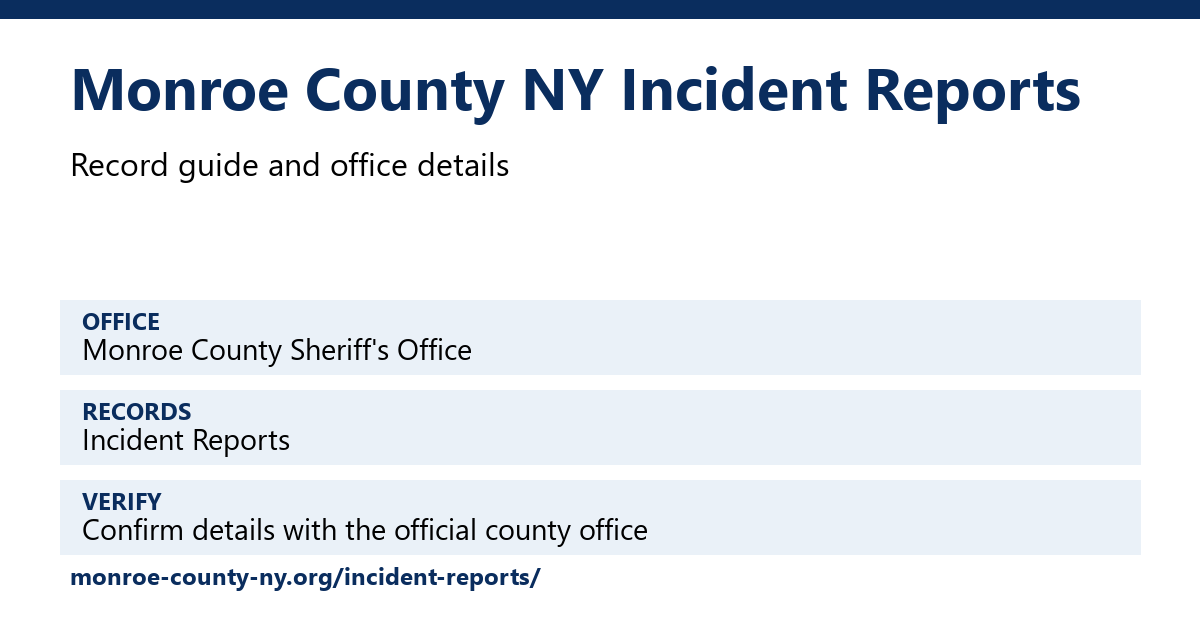
Police incident reports give Monroe County residents a written account of what officers observed at a call. The Monroe County Sheriff’s Office keeps these files for crashes, thefts, assaults, and other events handled inside Rochester and nearby towns. A copy can support an insurance claim, a court case, or a family record. Release rests with the agency that took the original call.
Getting a copy starts with the agency name, the date of the event, and any reference number printed on a receipt or card. Names of the people involved help staff narrow a search. Reports from an active case may stay closed for a time. Ask what the office can release before you file a request, and keep a note of every contact you make.
How to Search Incident Reports
An incident report search starts with the police records section of the Sheriff’s Office site, where a short request form or a records counter handles most inquiries.
- Open the Monroe County Sheriff’s Office website and find the records or report section.
- Use the short form for a report number, a date, or the location of the event.
- Visit a counter during business hours when you prefer to ask questions in person.
- Bring photo identification and the exact date of the incident with you.
- Ask staff to confirm the file exists before you pay for a copy.
- Note the date you submitted the request and keep that note.
Categories of Incident Reports
Files cover a wide range of calls, from a stolen bicycle to a serious collision on a state route. Each category carries its own retention period and release rules. A short incident description usually appears on the first page, followed by the narrative, the reporting person, and the names of any witnesses. Ask which category fits your request so staff can pull the right file without delay.
Theft, Burglary & Property Damage
Reports for stolen tools, damaged fences, or a break-in at a garage tend to include a list of property with an estimated value. Insurance companies often ask for that list and for the report number. Photographs taken at the scene may sit in the file but are not always released. Provide receipts or serial numbers when you request a copy, since those details help link the loss to your claim.
Traffic Collisions & Vehicle Incidents
Crash files usually name the drivers, the vehicles, the roadway conditions, and any citations issued. A traffic incident report may take longer to finish when an officer must interview several people or wait for a rebuild team. The state may hold a separate accident record. Keep the license plate numbers and the location handy, and ask whether the case is still open before you request the file.
Assault, Fraud & Financial Crimes
Cases that involve a fight, a scam, or a forged check often carry tighter limits on what the public may see. Detectives may withhold the narrative to protect a victim or to keep an inquiry intact. A fraud file can run long, with bank statements and phone logs attached. Ask the records unit which portions are open and whether a summary sheet is available instead of the full packet.
Missing Persons & General Service Calls
Not every file starts with a crime. Officers write reports for a missing person, a welfare check, a lost wallet, or a noise complaint, and those pages still hold useful facts. A missing person entry may list a physical description and the date the person was last seen. Families should call the Sheriff’s Office directly rather than wait on a web search result. Note the call date and the responding unit.
Obtaining Official Incident Reports & Files
Requests go to the agency that created the record, not to a statewide clearinghouse. For a city event, that may be the Rochester police department; for a town or village, it may be the Sheriff’s Office. Ask for the records unit by name and state whether you need an incident report or recent arrests in plain language. The office can explain its form, its fee schedule, and the usual turnaround time.
Online, In-Person & Mail Request Procedures
Online forms suit simple requests, and many agencies now accept an email inquiry before a formal filing. In-person visits let you ask questions and fix a missing detail on the spot. Mail works for people outside Monroe County, though it adds transit time. Include a daytime phone number, a self-addressed envelope if the office asks for one, and a clear description of the file you want.
Certified Copies, Processing Timelines & Copy Fees
A plain copy costs less than a certified one, and the certified version carries a seal that courts and insurers often demand. Processing timelines range from a few days to several weeks, with older files taking the longest. Fees are set by the office, so ask for a total before you send payment. Keep the receipt, and note the exact date, time, and clerk name on your request.
Public Availability, Redactions & Privacy
Rochester, NY 14614
Rochester, NY 14614
New York’s public records law favors disclosure, yet several exemptions let an agency withhold or black out material. Personal privacy, safety of a victim, and the integrity of a pending case are common grounds. A redacted page may still answer your question even when a full copy stays closed. Ask the office to explain any denial in writing so you can decide about an appeal.
Protected Victim, Witness & Juvenile Information
Names of young people, addresses of a domestic violence victim, and contact details for a witness can be removed before release. State law gives agencies room to shield those details, and staff may ask why you want the file. A journalist, an attorney, and a family member may receive different answers. Explain your purpose and let the records officer decide which parts can be shared.
Redacted Details & Confidential Record Rules
Blacked-out lines on a page signal that something was withheld, and the office should cite the reason. Some records carry a confidential label from the start, such as those tied to a child or a sealed court order. Do not assume a redacted file is useless; the remaining text often confirms a date, a location, or a case number. Keep the copy and request a written index of withheld items.
Record Accuracy & Resolution
Errors creep into files during a busy shift: a misspelled name, a transposed street number, or the wrong offense code. The reporting officer or the records unit can correct a clerical mistake, and the fix usually appears as an addendum rather than a rewrite. Read your copy line by line and list each problem with the page and line where it appears. Send the list to the records supervisor.
Processing Delays for Recently Filed Reports
A report written last night may not reach the public counter for several business days. Supervisors review each narrative, detectives may add follow-up notes, and the file waits until the case moves forward. A weekend or holiday stretches the gap. Call before you drive to the office, and ask the clerk whether the record has cleared review. A short wait is normal; a month is not.
Resolving Incorrect Case Numbers or Address Mismatches
Case numbers from a receipt, a court notice, and an officer’s card sometimes differ. Ask the records unit which number the agency uses as its master reference, and use that one in later requests. For an address problem, give the nearest cross street and the block number so staff can find the right location. Ask for a corrected copy once the clerk fixes the entry and signs it.
What to Do If an Incident Report Cannot Be Found
Start with a wider date range and alternate spellings of each name. Ask whether the call was handled by a different agency, a state trooper, or a village department that keeps its own files. A record may sit under a case ID rather than a name. If the office confirms that no file exists, request that answer in writing and note the date of the search.
Frequently Asked Questions
Readers often ask the same handful of questions about timing, privacy, and cost. The answers below reflect general practice at New York police agencies and should not be read as legal advice. Rules change, and each file carries its own facts. Treat each answer as a quick starting point. Confirm current details with the Monroe County Sheriff’s Office before you travel to the records counter or mail a payment.
How long after an incident occurs is the official report available?
Most routine files reach the counter within a week, and a crash with no injuries often moves faster. Cases that involve a detective, a lab test, or a serious charge can take much longer. The office will not promise a date during an open review. Call with the report number after a few days, and ask whether anything is missing from your request. Bring your photo identification to the counter.
Can an involved party request an unredacted copy of an incident report?
Sometimes, yes, but the answer depends on the role of the person asking and the stage of the case. A victim, an owner of damaged property, or a defense attorney may have a stronger claim than a curious neighbor. The office can ask for identification and a signed release. Expect some lines to stay blacked out regardless of who submits the request. Ask in writing, and keep the reply.
What is the difference between an incident report and a formal arrest record?
One describes an event; the other tracks a person through the booking process. An incident report may never lead to an arrest, and many calls end with advice or a referral. An arrest record lists charges, fingerprints, and a court date. Ask for each document by its proper name, since a clerk cannot always guess which one you mean. One can exist without the other, so ask for both.
Who should I contact if an incident report contains factual errors?
Call the agency that wrote the file and ask for the records supervisor, not the emergency line. Give the report number, the page, and a short description of what is wrong. Bring proof for a name or date correction, such as a license or a birth certificate. If the error affects a court case, tell your attorney and the clerk so the docket can be updated.