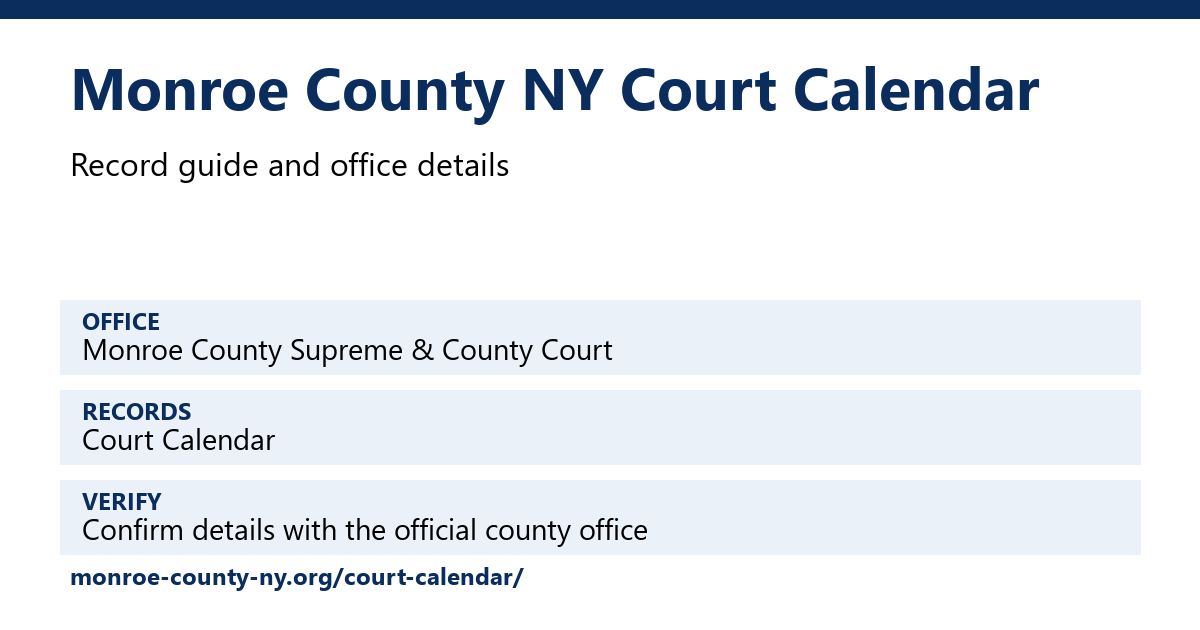
State Supreme and County Court calendars in Monroe County list the cases scheduled before each judge on a given day. Rochester residents, attorneys, and journalists check the court calendar to confirm a court date, a courtroom number, and a start time. The Hall of Justice at 99 Exchange Blvd. holds the main trial parts. Online listings help readers plan a visit before traveling downtown.
Calendars change often. A hearing may be adjourned, moved to another part, or resolved before the listed date. Phone lines at 585-371-3758 cover questions during Monday-Friday, 9:00 a.m.-5:00 p.m. Note the index number and the date printed on the listing. Confirm details with the court clerk before you arrange time off work or hire a court reporter.
Court Calendar Search
Begin a calendar search with the case index number from court records when you have it. The public listing for Monroe County Supreme and County Court accepts a name, a date, or a judge, then returns matching court dates. Read the disclaimer on the results screen. Popular lookups include court date search by case number and hearing schedule checks for a single day. Write down every field you see.
Court Schedule Information
A published court schedule groups appearances by date, part, and judge. Each row of the hearing calendar should show a time, a room, a case caption, and a status. Treat the printed version as a snapshot, since clerks revise entries as papers arrive. The main office answers schedule questions at 585-371-3758 during weekday business hours. Check monroe county ny records for the calendar you should follow, then print the page if a hearing matters.
Hearing Time & Courtroom Location
Every entry carries a hearing time and a courtroom number, and both can shift on the day of argument. Most Supreme Court parts sit on the 5th Floor of the Hall of Justice, with the main office in Room 545 at 99 Exchange Blvd. in Rochester. Arrive early enough for security screening. Confirm the room with the clerk if the notice lists only a part, and ask for the nearest elevator.
Case Number & Listed Parties
The index or case number ties a calendar row to the right file, and party names separate matters that share a judge. Verify the spelling of each listed name against your own papers before you rely on a match. Common names produce several hits. A court docket calendar entry identifies the parties, not the outcome. Bring the number to the counter for anything unclear. Photograph the screen when a clerk confirms the details.
Hearing Type & Presiding Judge
Calendars label each appearance with a hearing type and the presiding judge. A motion hearing, a status conference, and a sentencing all carry different expectations for preparation. Judge assignments can rotate after a transfer or a recusal. Check the judicial calendar by judge when your matter may have moved. The label on the screen tells you what the court expects that day. Court staff can explain a label you do not recognize.
Calendar Status Codes
Short codes on a calendar flag whether an appearance is on, adjourned, submitted, or cancelled. Codes differ between the Supreme Court and County Court parts, so a legend usually sits near the top of the list. When a code is unfamiliar, ask the clerk rather than guessing. A cancelled entry still deserves a call, since notices sometimes lag behind the list. Keep that note with your case paperwork.
Types of Court Hearings
The Monroe County court hearing schedule covers a wide range of proceedings, from first appearances to post-judgment arguments. Knowing which category applies helps you read the calendar with realistic expectations about length and attendance. Civil, criminal, and family matters each follow their own rules and their own rooms. Town and city courts, Family Court, and Surrogate’s Court keep separate jurisdiction and contacts. Confirm the division before you travel.
Civil, Criminal & Family Dockets
Civil dockets list lawsuits, foreclosures, and contract disputes. Criminal dockets cover felony and misdemeanor matters bound over to the higher court. Family Calendars, which handle custody, support, and neglect petitions, run through a separate court with its own staff. Matching the docket type to the right building saves a wasted trip. Bring photo identification and your notice for any in-person appearance. Ask the clerk which courtroom handles a given docket.
Arraignments & Pretrial Hearings
An arraignment hearing puts the charges on the record and sets the next step. Pretrial hearings cover discovery disputes, suppression motions, and plea discussions. Both appear on the daily calendar, often with short windows. Defense attorneys and prosecutors check the same list. If you are the accused, arrive with counsel or ask about assigned representation before the call. Confirm the time on the morning of the appearance.
Motions, Trials & Sentencings
Motion arguments, bench and jury trials, and sentencings occupy most of the trial calendar. A trial date can hold for weeks as the court manages other cases, so confirm it close to the day. Sentencing dates follow a plea or a verdict and rarely move without a written order. Check the courtroom number twice, since trial parts sometimes swap rooms at short notice. Bring the notice for the officer at the door.
Schedule Changes & Remote Access
Court dates move for many reasons: a sick witness, a late filing, a settlement, or a judicial assignment change. The online court schedule reflects most adjustments, yet the paper notice in your file still matters. Remote appearances use video or telephone for some calendar calls. Ask the clerk which method applies to your part, and test the technology a day ahead so a login problem does not cost you the appearance.
Rescheduled & Continued Hearings
A rescheduled hearing receives a new date, and the old entry may linger on some lists for a short time. Continued matters keep the same case number as the court sets a future return date. Compare the update stamp against your notice. When two dates appear, call the clerk and ask which one controls. Record the name of the person who confirms the change. Keep that name in your file.
Rochester, NY 14614
Rochester, NY 14614
Rochester, NY 14614
In-Person Attendance Rules
Visitors pass through a security checkpoint before entering the Hall of Justice. Expect bag screening, metal detectors, and a limit on electronics in some courtrooms. Courtrooms open shortly before the calendar call. Seating is limited, and a judge may close a proceeding to the public. Check the rules posted at the entrance, and allow extra time on mornings with a heavy docket. Plan on arriving at least thirty minutes early.
Virtual Hearing Links
When a judge allows a remote appearance, the court sends an invitation with a meeting identifier and a dial-in number. Those details arrive through the case file or from counsel, never from a public calendar row. Do not share an invitation with anyone outside the case. Join early, mute your line, and identify yourself when the clerk takes appearances. A recording of the session usually requires permission.
Schedule Accuracy & Resolution
No public listing stays current every hour. Clerks enter changes as they process papers, and a busy calendar day slows that work. Readers should treat a search result as a starting point for confirmation, not as a final order. Keep your own copy of each notice. The Supreme and County Court main office at 585-371-3758 can resolve most questions about a specific date. Save a copy of each update you find.
Calendar Update Delays
Updates can lag by hours when the court is in session. A hearing that settled at 9:00 a.m. may still appear on a mid-afternoon list. Weekend and holiday filings wait for the next business day. Check the timestamp, then check again later in the day. For a same-day appearance, a phone call beats a refresh. Note the time of each check for your records. Leave a message if the line is busy.
Confidential & Sealed Hearings
Some matters never reach the public calendar. Sealed files, juvenile proceedings, and matters involving protected witnesses are handled outside the open list. A missing entry does not mean the case disappeared. Ask the clerk whether a matter is sealed, and expect a limited answer. Attorneys of record can review more through the case file than a visitor can see at the counter. Bring the case number when you ask in person.
Missing Schedule Resolution
If a search returns nothing, verify the spelling, the index number, and the court. A case filed in a town or city court will not appear on the Supreme and County Court list. Call 585-371-3758 during Monday-Friday, 9:00 a.m.-5:00 p.m. and describe what you need. Ask which office holds the record, then follow that office’s process. Write down the name of the person who helps you.
Frequently Asked Questions
These answers cover common questions about the Monroe County calendar. They describe general practice at the Hall of Justice, not legal advice about a specific case. Rules and posting habits can change, and a clerk’s confirmation always outranks a web listing. Use the office address at 99 Exchange Blvd., Rochester, NY 14614, and the phone line, for anything that affects a real appearance. Keep your index number within reach when you call.
When are daily court schedules updated?
Most daily calendars post before the morning call, with revisions during the day as adjournments arrive. A specific hour varies by part and by staffing. Check early, then check again after lunch if your matter is scheduled for the afternoon. A hearing that settles in the morning may remain listed until a clerk updates the entry. The courtroom deputy can confirm the current order. Check once more before you leave for the courthouse.
How do I verify a rescheduled court date?
Compare the date on your written notice with the date shown in the online listing. When the two differ, call the clerk at 585-371-3758 and read the case number aloud. Ask for the controlling date and the name of the person who confirms it. Request an updated notice if the file shows a change. Save the confirmation with your other case papers. Ask for a confirmation number if the office offers one.
Are virtual hearings open to the public?
Remote participation depends on the judge and the type of proceeding. Many calendar calls allow the public to listen, with instructions posted by the court. Others restrict entry to parties, counsel, and witnesses. Sealed and juvenile matters stay closed. Ask the clerk before you request an invitation, and respect any instruction to mute your line or withhold recording during the session. Follow the clerk’s instruction on how to identify yourself.
Who confirms unlisted court appearances? .
The clerk’s office for the part that holds the case confirms anything the public list omits. Staff can check the internal file and explain why an entry is absent. Bring the case number, the party names, and the date you expected. For matters outside Supreme and County Court, the town, city, family, or surrogate clerk answers instead. Expect counter hours of Monday-Friday, 9:00 a.m.-5:00 p.m.