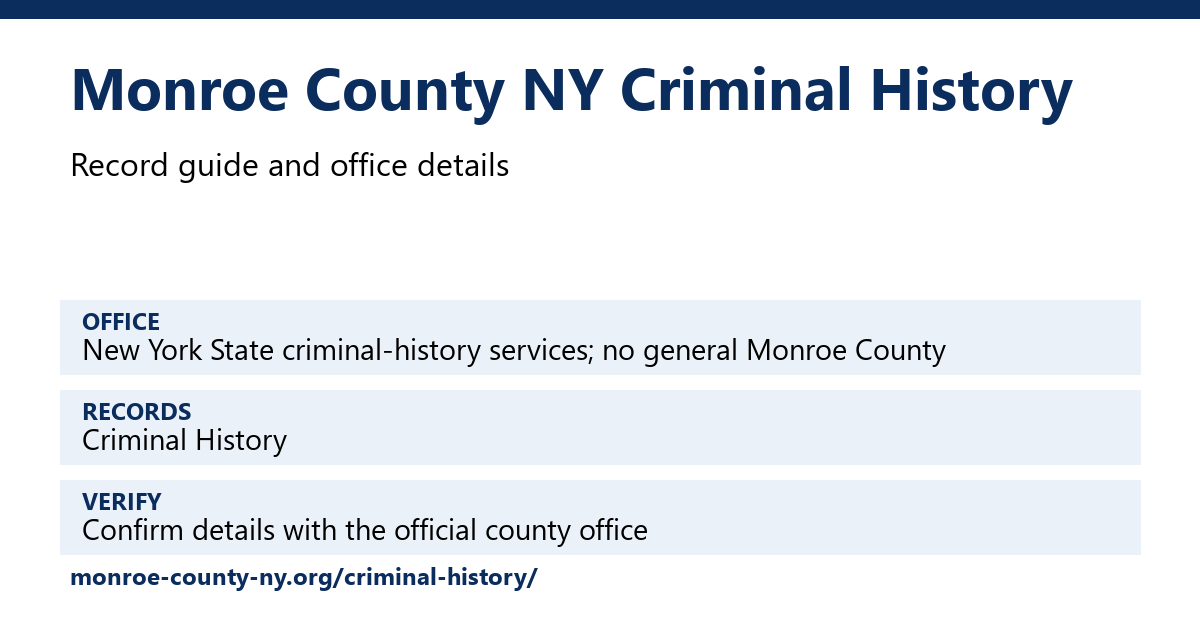
New York keeps criminal history information in more than one place, and no single Monroe County office publishes a general background file for public use. State agencies control the official channels, and courts hold case files for charges filed in Rochester and the surrounding towns. Knowing which source handles which detail saves time for anyone checking a case.
Readers often start with a name and a date, then widen the search when a result looks thin. A charge filed in a local court is not the same as a statewide background check, and a name match alone proves little. Treat each listing as a lead, then confirm identity and case outcome through the agency or clerk that holds the file.
Criminal History Search
Begin with the court that handled the case, not with a general people-search site. Monroe County criminal records sit with the courts, and the state record review process handles fingerprint-based background checks for eligible requesters. Have a full legal name, a date of birth, and any case number ready. Read each site’s rules before you pay for a report. A clerk can point you to the right index for that year.
Record Contents & Offense Types
A case file usually names the defendant, the charging document, the statute, and the court. Entries may show a felony or a misdemeanor, the date of the offense, and the arresting agency. Some files in felony records include a plea, a finding, and a sentence, plus a note on restitution or a fine. Details vary by court and by the age of the case. Older paper files may hold less than a modern docket.
Subject Identity & Arrest Logs
Identity details tie a file to one person: full name, birth date, last known address, and sometimes a booking number. Arrest logs add the date, the place of arrest, and the agency that made the stop. Those entries describe an accusation, not a result. Ask the clerk to confirm that the name and birth date on the file match the person you are checking before you share it.
Misdemeanor & Felony Charges
New York divides offenses by severity, and the class shapes what follows. A misdemeanor can bring a fine, probation, or a short jail term; a felony carries heavier exposure and often a state sentence. The charging document lists the section and the class. A later plea may reduce the charge, so read the disposition, not the first entry on the docket. Sentencing exposure depends on the class and on the prior record.
Sentences, Fines & Case Dispositions
A disposition records how a case ended: a plea, a trial verdict, a dismissal, or an adjournment in contemplation of dismissal. The sentence may add prison time, probation, a fine, restitution, or a conditional discharge. Fines sit with the court that imposed them. Ask the clerk for the sentencing entry when you need the exact term, the credit for time served, and the conditions. A fine may carry a surcharge and a payment schedule.
Differentiating Arrests & Convictions
An arrest marks a person’s entry into the system; a conviction follows a plea or a trial finding. Many files contain the first and never the second. A dismissed charge or an acquittal is an outcome too, and it belongs in a fair reading of the record. Never call someone convicted on the strength of a booking entry alone. Court papers use precise language for each stage, and that wording matters.
Case Status & Public Availability
Most criminal court files in New York are open to inspection, with limits for sealed matters and for cases involving young people. The court docket shows whether a case is open, closed, or on appeal. A public terminal at the courthouse may hold more than a county website. Check the court’s own record for the current status before you rely on a summary from elsewhere or on a newspaper account.
Active, Pending & Closed Cases
An active case has future court dates and no final order. A pending case may wait on a lab report, a plea offer, or a hearing. Closed cases carry a disposition and often a sentence. Some dockets show a reopened file after an appeal or a violation petition. Look at the last entry date to judge whether the status line still holds. Status can flip after one appearance.
Dismissals, Acquittals & Convictions
A dismissal ends the case before a verdict, sometimes with conditions attached. An acquittal follows a trial and a not-guilty finding. A conviction rests on a plea or a guilty verdict. Each outcome carries a different weight for housing, licensing, and employment questions. Read the exact wording of the disposition and keep a copy of the docket entry for your files. Sealing rules can hide an old dismissal from a later employer check.
Online Directories & Public File Rules
Commercial directories gather court data and republish it, and their entries can lag or mix up two people with the same name. Use them as a pointer, not as proof. The official docket and the state record review process remain the sources that matter. Expect fees, identity checks, and eligibility limits for a fingerprint-based state check. A directory may show an arrest with no note that the charge was dropped.
Expunged, Sealed & Juvenile File Rules
Rochester, NY 14614
Rochester, NY 14614
New York seals many records after a waiting period, and some drug and youthful offender matters close to public view from the start. Sealed files may still be visible to a judge, a prosecutor, or a licensing agency. Juvenile matters follow a separate set of rules. A missing public entry can mean a sealed file rather than no case at all. State law sets the waiting periods and the list of eligible offenses.
Record Accuracy & Resolution
Errors creep into indexes through misspelled names, transposed birth dates, and merged files. A wrong entry can follow a person for years if nobody corrects it. Start with the court clerk, show the docket number, and point to the specific field that is wrong. Ask what proof the office needs and how long a correction takes to appear. Keep a dated copy of every correction request you send.
Identity Verification & DOB Matching
A name alone is weak evidence. Birth date, middle name, and the last four digits of a case number narrow a list fast. Ask the clerk to read the birth date on the file, then compare it with the one you hold. A shared name is common, and a mismatch on the birth date usually ends the question. Bring a photo ID when you visit the counter in person.
Handling Multiple Name Matches
Several files may carry the same name, and a few may belong to the same person. Sort them by birth date, then by the court and the year. Look for a pattern of addresses or a repeated case number. Discard entries that fail two or three checks. Call the clerk with the strongest candidate and ask for a confirmation of identifiers. Write the reason for each rejection so the file stays clear.
System Delays & Missing Record Resolution
New filings can take days to reach a public index, and a case that moved between courts may sit in two systems. A search that returns nothing may have hit a spelling variant or a maiden name. Try the docket number, then the year, then the court. Ask the records office to check its internal index before you accept a blank result. Ask for the index name the office uses for that court.
Frequently Asked Questions
These questions come up often when people check a case in Monroe County. The answers describe general practice and the state process, not legal advice about one file. Rules on sealing, fees, and eligibility change, so confirm the current terms with the court or the state agency before you file a request or rely on a report for a job, a lease, or a license. Ask for the records desk by name.
Are criminal history records public in New York?
Court dockets are largely open, and a state background check follows a different path. New York’s record review program releases criminal record information to the person named in the record and to certain employers or agencies with legal authority. The general public cannot walk in and buy a full statewide file. Eligibility rules and fees sit with the state agency. A personal record request usually needs fingerprints and a fee.
Do criminal records list dismissed charges?
A docket usually keeps every charge filed, including ones later dismissed, and the disposition shows the outcome. A sealed case may drop from public view, and a conditional dismissal can close the file after a period of good behavior. Read the final entry, not the charging line. Ask the clerk whether the record remains public. Some courts add the reason for the dismissal to the final entry.
How long after disposition do records update online?
An update can appear within days, or it can lag for weeks when a court enters paper orders and staff key them in later. A sentence calculation may add more delay. Check the docket for the last entry date, then call the clerk if a disposition is missing. Keep the case number and the hearing date for the call. A holiday week or a backlog can stretch that window.
Who confirms missing criminal history files in Monroe County?
Start with the clerk of the court that handled the case, since that office holds the docket and the orders. For a statewide background check, the state agency that runs record review answers questions about a missing or incomplete response. Local police can confirm an arrest report. Each office speaks only to its own files, so expect several calls. Write down the name of each person who helps you.