Monroe County NY sits in western New York along Lake Ontario, with Rochester at its center. This home page links record systems that residents, researchers, and families ask about. It covers jail and court files, property and tax records, birth and death certificates, business filings, and county offices. Each section points to the office that holds the record and the steps that usually follow.
Use this page as a starting point, not a final answer. Record rules can change, and a search result may lag behind a new filing. Confirm details with the office named in each section before you travel, pay a fee, or send a request. A clear name, date, and case or parcel number can shorten the process. Keep a copy of each request and response.
Inmate Search & Jail Records
The Monroe County Sheriff’s Office runs the county jail system and holds booking records for people arrested in the area. A jail search may show a current roster, recent bookings, or release history. Results can lag after a new arrest, and a name match does not prove identity. Use a booking number when you have one, and confirm custody with the jail before a visit.
Current Inmate Roster & Population
The current inmate roster lists people held at the county jail at a point in time. A record may show a name, booking date, charge, and housing unit. Population counts can change during the day as bookings, releases, and transfers move forward. The Sheriff’s Office controls what it publishes. Check the update time on the page and call the jail for the latest status. A jail visit can change the count within minutes.
Recent Bookings & Mugshots
Recent bookings can appear in a jail log or a public booking page. A mugshot may be posted with the entry, but not every facility releases photos for every arrest. A booking is an intake record, not a conviction. Use the name, date, and charge together before you accept a match. Ask the Sheriff’s Office about photo rules and record updates. Photo release rules can differ from booking record rules.
Releases & Booking History
Release records show when a person left custody and may include a booking history. A release date can move after a court order, bail posting, or sentence calculation. Some systems keep a short release list; others remove the entry at once. A missing record does not prove that no arrest occurred. Call the jail for release details and ask for the booking number. Ask for the release time and the date.
Arrests & Warrants
Arrest records and warrant files sit with different agencies. Local police keep arrest reports, the Sheriff’s Office holds jail bookings, and courts issue warrants. A warrant may be active, recalled, or served. An arrest does not establish guilt, and a warrant listing can be outdated. Confirm the current status with the agency or court named in the record before you act. A court clerk can confirm whether a warrant is still open.
Arrest Records & Recent Arrests
An arrest record may include the date, location, charge, and arresting agency. Recent arrests can appear in a police blotter or a jail booking log. The same event may be described in more than one system. A charge is an allegation, not a finding of guilt. Check the court file for the case outcome and confirm the person’s identity before you rely on the entry.
Active Warrant Search & Wanted Persons
An active warrant search can show a name, charge, and the court that issued the warrant. Some agencies publish wanted lists; others ask you to call. A warrant may be recalled or served after the list was posted. Do not try to detain or confront a person named in a warrant. Contact the Sheriff’s Office or local police with the case number. A wanted list may not include every open warrant.
Bench Warrants
A bench warrant comes from a judge, often after a missed court date or a violation of a court order. The warrant may set bail or a release condition. Bench warrant records can sit with the court that issued them. Ask the clerk for the case number and current status. A court may recall the warrant after a new appearance or payment. A missed payment can lead to a new court date.
Criminal History & Background Checks
New York criminal history checks follow state rules and are not the same as a local jail search. A fingerprint-based review may be needed for some purposes. Employers, landlords, and volunteer groups may face limits on how they use criminal records. A name-only web search can miss sealed or older cases. Use the state process and a qualified provider for official checks. State and federal checks follow different rules.
Felony & DUI Records
Felony and DUI cases move through the criminal courts, not the jail records office. A case file may show charges, pleas, findings, and sentences. A DUI arrest can involve a license action separate from the criminal case. A charge is not a conviction. Check the court docket for the current status and ask the clerk about copies of specific documents. A DUI case may involve both a criminal and a license file.
Court Records
Monroe County courts handle criminal, civil, family, probate, and traffic matters. The court that heard the case keeps the file, and the clerk controls public review. Some documents can be viewed online; others require a visit or a written request. A case number is the fastest way to find a file. Confirm the court, courtroom, and date before you travel. Ask the clerk which records are open to public review.
Case Search by Name or Case Number
A case search works best with a case number. If you have only a name, try the exact spelling and a date range. The state court system may offer an online index, but it may not include every document or every court. A name match can involve another person. Confirm the case type, county, and parties with the clerk. A case number usually returns the most complete result.
Court Dockets, Schedules & Hearings
A court docket lists the events in a case, such as filings, motions, hearings, and judgments. A schedule can change after a continuance or a judge’s order. Check the docket close to the hearing date and confirm the courtroom. Some calendars are posted online; others are available only at the courthouse. Arrive early and bring the case number. A docket entry may not include the full document.
Criminal Court Records
Criminal court records can include an accusatory instrument, arraignment notes, motions, plea documents, and a sentence. The file may be sealed or restricted after a dismissal or a youthful offender finding. A public index may show that a case exists without showing every document. Ask the clerk which records you can review and what copies cost. Some files need a judge’s permission before release, and a clerk can explain the review steps.
Civil & Family Court Records
Civil and family court files cover disputes, contracts, custody, support, and protective matters. Family Court records often carry privacy limits, and some documents may be sealed. A civil index may show the parties, case number, and filing dates. Ask the clerk about review rules and copy fees. Do not assume that an online entry includes the full file. A sealed file may still be listed in the index.
Probate & Estate Records
Probate files sit with the Surrogate’s Court and may include a will, petition, letters, inventory, and accountings. Older estates can be held on microfilm or in archived files. A probate search may need the decedent’s name and date of death. Some records are open; others need a showing of interest. Confirm the file number and copy rules with the court. A creditor claim can add a new filing to the estate.
Traffic Court Records
Traffic cases can be heard in town, village, city, or county courts. A ticket record may show the charge, plea, fine, and disposition. The court that handles the ticket keeps the file, not the jail or the police agency. A conviction can affect a license or insurance. Check the court docket and ask about payment or appeal steps. A ticket can be answered by mail, online, or in person.
Vital Records
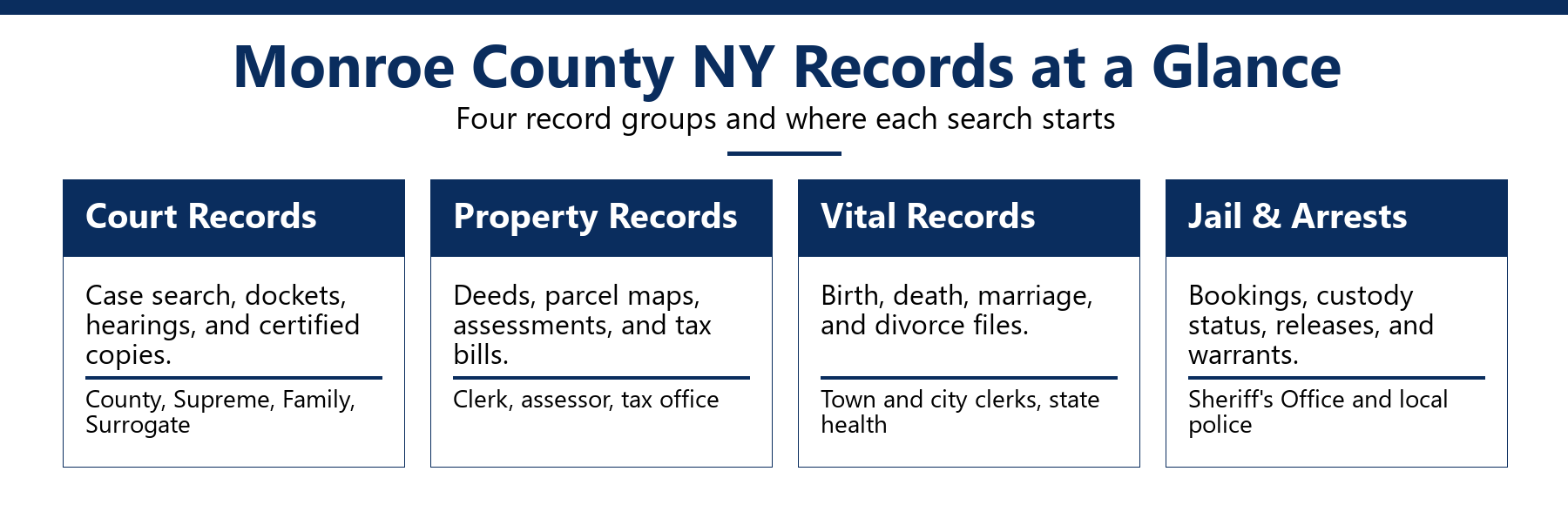
Birth, death, marriage, and divorce records come from different offices. Town and city clerks hold local birth and death records, the County Clerk files marriage licenses, and the court system handles divorce files. The state Health Department issues copies for events across New York. Rules on who can request a copy depend on the record type and its age. A current certificate and an older record can follow different rules.
Birth & Death Records
A birth or death certificate request usually goes to the clerk in the town or city where the event occurred. The state Health Department can issue copies for New York events. You may need identification, a relationship to the person, and a fee. Older records may be available for family research. Confirm the current form and office before you mail a request. A delayed birth certificate may need extra proof.
Marriage Licenses & Divorce Decrees
A marriage license is filed with the clerk in the town or city where it was issued. A divorce decree comes from the court that granted the judgment. A certified copy may be needed for a name change, insurance, or immigration matter. The records are not held in the same office. Ask each office for its copy rules and fees. A divorce file may include a settlement or custody order.
Genealogy Records & Historical Obituaries
Family research can draw on old birth and death registers, marriage records, cemetery files, newspapers, and probate packets. Many local records are on microfilm or in a historical society collection. A death index can help locate a certificate number. Obituaries may add family details that a certificate does not show. Check each archive’s hours and copy rules. A local library or historical society may hold the missing index.
Property Records
Property records connect a parcel to an owner, a deed, a tax bill, and a map. The County Clerk files deeds and mortgages, the assessor sets a value, and the tax office collects payments. A parcel number helps link these records. A current owner may differ from the name on an older deed. Confirm the parcel and document before a purchase or dispute. A title search can reveal a lien that a tax bill misses.
Property Search by Address or Owner
A property search can start with an address, owner name, or parcel number. The county GIS and assessment sites may show the parcel, owner, value, and tax history. A deed index can confirm the recorded owner and sale date. A name search may return several parcels. Check the legal description and the latest deed before you rely on the result. A parcel number can remove confusion between similar addresses.
Deeds, Titles & Parcel Maps
A deed transfers an interest in land and is recorded with the County Clerk. A title search can show mortgages, liens, easements, and judgments that affect the property. A parcel map shows boundaries, not ownership by itself. The map and the deed should be read together. Ask a title professional for a full search before a purchase. A survey can resolve a boundary that the map leaves unclear.
Property Tax Records & Tax Liens
Property tax records show an assessed value, a tax bill, payments, and any unpaid balance. A tax lien may attach when charges go unpaid, and the county or town can follow a set process. A tax sale is not the same as a foreclosure. Check the tax office for the current balance and any payment plan. Confirm the parcel number before you pay. A payment plan may not stop a lien from growing.
Police & Incident Records
Police reports and incident logs come from the agency that responded to a call. The Monroe County Sheriff’s Office covers the county, and city, town, and village departments handle local calls. A report may be released to a victim, an insurer, or another party with a legal interest. Some active files are withheld. Ask the records unit for the report number and release rules. A victim may request a copy through the records unit.
Police Reports & Incident Blotter
A police report can include the date, location, parties, charges, and a narrative. An incident blotter is a short log, not the full report. The agency that took the report controls release and may require a written request. A report about a person does not prove guilt. Ask for the report number and the records unit that handles the file. A report may be redacted before release.
Traffic Violation Records
A traffic violation record can appear in a court file, a police report, or a state driving record. The court handles the ticket, fine, and disposition. The state DMV handles license points and driving history. A ticket may be dismissed or reduced. Check the court docket for the case result and request a certified abstract from the DMV for driving history. A court clerk can confirm the fine and due date.
Accident & Crash Reports
A crash report can be filed by a police agency or by a driver after an accident. The report may include vehicles, injuries, witnesses, and a diagram. Insurance companies often request a copy. The agency that took the report can explain release rules and fees. A report number, date, and location help locate the file. Confirm the current process before you send a request. A police report number can speed up an insurance claim.
People & Phone Search
People search tools can help locate a name, address, phone number, or possible relative. Some sources are public directories; others are private databases with their own rules. A name match can be wrong, and a phone number can change hands. Use these tools with care and follow privacy laws. For official records, contact the agency that holds the file. A public directory may not include a mobile number.
Person & Residents Directory
A resident directory may list a name, address, and phone number from public or commercial sources. A county office does not publish a full resident list. Property and voter files can confirm an address, but each has limits. A person may share a name with someone else. Check more than one detail before you contact anyone, and respect do-not-call rules. A voter file can confirm a name and address.
Reverse Phone Lookup
A reverse phone lookup can link a number to a name, address, or business. Free directories may be outdated, and paid services can vary in quality. A mobile number is often harder to match than a landline. Do not use a lookup to harass or impersonate anyone. Confirm the result with a second source and follow applicable privacy rules. A business number is often easier to confirm than a mobile.
Public Contact Information
Public contact information can include a government office, a business, or a licensed professional. A county directory may list department phones and addresses. A business filing can show a registered agent and service address. A professional license lookup can confirm a credential. Use the official source for each type. Do not treat a commercial listing as a government record. A state license lookup can confirm a professional’s status.
Vehicle Records
Vehicle records come from the New York DMV and from local police or courts. A plate or VIN can help identify a car, but the DMV limits what it releases. A registration or title record may be available to the owner or a party with a legal interest. A crash or ticket record sits with the agency that handled it. Confirm the record type before you request a copy.
License Plate & VIN Lookup
A license plate or VIN lookup can help confirm a vehicle’s make, model, and registration status. The DMV controls official records and may require a permissible purpose. A free online tool may return limited or outdated data. A VIN check can show recalls, liens, or title brands. Use the DMV and a reputable history service before a purchase. A plate check can show a registration status, not a driver.
Vehicle Registration & Title Records
A vehicle registration shows the plate, owner, and registration period. A title record shows ownership and any liens. The DMV releases these records under set rules, often to the owner, an insurer, or a party with a legal interest. A duplicate title or registration may require a form and fee. Check the DMV site for the current process. A lien on a title can block a sale or loan.
Business Records
Business records in New York come from the Department of State and from local offices. A corporation or LLC files formation papers with the state. A sole proprietor may file a business certificate with the county clerk. A UCC filing can show a secured loan. A business search can confirm a name, status, and registered agent. Check each source for the current filing. A business certificate can expire and need renewal.
Business Search & Entity Lookup
A business entity search can show a legal name, entity type, filing date, status, and registered agent. The Department of State maintains the main database for corporations, LLCs, and partnerships. A name search may return similar entities. A business certificate filed with the county clerk covers some sole proprietors. Confirm the entity number and current status before you rely on a listing. A registered agent address may differ from the business address.
Assumed Name (DBA) Filings
An assumed name, or DBA, lets a business operate under a name that differs from its legal name. A sole proprietor files a business certificate with the county clerk where the business is located. A corporation or LLC may file an assumed name with the state. A DBA does not create a new legal entity. Ask the filing office for the current form and fee.
UCC Records & Liens
A UCC filing records a secured interest in collateral, such as equipment or inventory. The filing can help a lender protect a loan. A UCC search may show a debtor, a secured party, and a filing date. A lien can affect a business sale or a loan. Check the state filing office and ask for a copy of the financing statement. A terminated filing may still appear in an older search.
Public Records & Government Requests
New York’s Freedom of Information Law lets the public request records from government agencies. A request should name the record, the office, and the date range. The agency may charge a copy fee and may deny a request under a listed exemption. A court file follows court rules, not FOIL. Send the request to the records officer for the correct office. A request should ask for a specific record, not an answer.
Open Records & FOIL Requests
A FOIL request asks an agency for an existing record. Write a clear description and avoid asking the agency to create a new document. The agency must respond within a set time, but extensions are possible. A denial should state the reason and the appeal path. Keep a copy of the request and the response. Some records are exempt from release. A narrow request is easier for an agency to answer.
Records by Department
Each county department keeps its own files. The Clerk holds land and some court records, the Sheriff holds jail and police records, the Finance office holds tax and budget files, and the Health Department holds birth and death records. A request sent to the wrong office can delay the process. Check the department directory and send the request to the records officer. A department directory can confirm the right records officer.
County Government
Monroe County government includes the County Executive, the Legislature, the Clerk, the Sheriff, the courts, and several departments. The county seat is Rochester, and many offices sit in the downtown civic center area. Each office sets its own hours and records rules. Check the county website for the current address, phone, and service counter before you visit. The county website lists office hours and service counters.
Rochester, NY 14614
Rochester, NY 14614
Rochester, NY 14614
County Clerk & Court Clerk
The County Clerk files deeds, mortgages, and some business certificates, and handles several licensing functions. A court clerk keeps the files for the court that heard a case. The two roles are separate. A deed question goes to the County Clerk; a case question goes to the court clerk. Confirm the office and the document type before you send a request. A recorded document can be copied for a set fee.
County Finance & Tax Office
The Finance Department manages the county budget, payments, and some tax functions. Town and city tax offices collect property taxes, and the county treasurer may handle delinquent accounts. A tax question should start with the bill and the parcel number. Ask the office named on the bill for the current balance, payment options, and any lien status. A receipt and parcel number can speed up a tax question.
Sheriff’s Office
The Monroe County Sheriff’s Office provides patrol, jail, court security, and civil services. It holds jail bookings and some police reports. The main office is in Rochester. A records request should name the report or booking number and the unit that handles the file. Call before you visit to confirm counter hours and release rules. The office can confirm which unit holds a report or booking.
County Court & Surrogate’s Court
Monroe County Court handles felony and some civil matters, and the Surrogate’s Court handles probate and estate files. The Supreme Court and Family Court sit in the county. Each court keeps its own records and follows its own review rules. A case number and the court name are the fastest way to find a file. Ask the clerk about copies and fees. A court clerk can confirm the courtroom and calendar.
Elections & Voter Information
The Monroe County Board of Elections runs voter registration, early voting, and election results. A voter can check a registration, find a poll site, or request an absentee ballot. A candidate or committee files campaign finance reports with the state. Election districts and maps can change after a census. Use the board’s official site for current dates and deadlines. A sample ballot can help before you enter the poll site.
GIS & Interactive Maps
GIS maps show parcels, streets, districts, and other layers in a digital viewer. Monroe County and the city of Rochester publish map tools for property, planning, and public safety. A map is a visual aid, not a legal record. A parcel line can be approximate. Use the deed and the tax record to confirm ownership and boundaries before a transaction. A map layer can be turned off to show a clearer parcel view.
Property & Parcel Boundary Maps
A parcel map shows a lot’s outline, number, and nearby streets. The county GIS viewer may add owner, assessment, and zoning layers. A boundary can be generalized, and a fence or driveway may not match the deed. For a legal boundary, use a survey and the recorded deed. Check the map date and the parcel number before you rely on it. A survey marker can differ from a line on the screen.
Precinct & Voting District Maps
Precinct and district maps show where voters cast ballots and which offices represent an area. The Board of Elections publishes poll sites and district lines. A district can change after redistricting. A map may show a boundary that differs from a tax parcel or a school district. Use the election office map for voting questions and confirm your registration before election day. A poll site can move after a building closure.
Unclaimed Funds & Property
Unclaimed funds are money or property held by a government office after an owner cannot be found. New York’s Comptroller holds unclaimed funds from banks, insurers, utilities, and other sources. A county may hold unclaimed property from estates or abandoned accounts. A search is free. A claimant must prove identity and ownership before a payment is released. A free state search is the safest place to start.
Unclaimed Property Search
An unclaimed property search can start with a name and a former address. The state Comptroller’s database covers many types of funds. A county treasurer or Surrogate’s Court may hold other items. Search variations of the name and check old addresses. A match is not a guarantee of payment. File a claim with the office that lists the property. A former address can help match an old account.
How to Claim Unclaimed Funds
A claim usually requires identification, proof of address, and a link to the property or account. An estate claim may need a death certificate, a will, and letters of administration. The office may ask for more documents before it approves a payment. Keep copies of everything you send. Check the official site for the current form and any fee rules. A notary may be needed for some claim forms.